If you enjoy playing Strat-O-Matic Pro Football solitaire with cards and dice, you probably use charts to help you determine your opponent's decisions. For offensive plays, Strat-O-Matic suggests using the following decision chart, which is available in the updated 2016 rules.
 |
| Down and Yard Situation Chart |
The official Down and Yard Situation Chart doesn't take into account the way specific teams called plays during a specific season.
Pro Football Reference to the rescue
If you would like to know more accurate offensive play call probabilities for a specific team, you can leverage the statics available on Pro Football Reference. You can use the web site's
Game Play Finder to find out which plays a specific team called during a specific season for the year 1994 and later.
In the Detail column in the query results, the Game Play Finder will tell you the name of the passer, receiver, completion status, distance, direction, yardage, and tacklers. You need to figure out how those results match up with Strat-O-Matic, however.
For example, the Game Play Finder will give you results for runs over left end, left tackle, left guard, middle, right guard, right tackle, and right end. In Strat-O-Matic, runs over left guard, middle, and right guard fall into the Linebuck play category.
Game Play Finder will give you results for receptions as short left, short middle, short right, deep left, deep middle, and deep right. The short left and short right passes fall into the Flat Pass category in Strat-O-Matic, short middle passes fall into the Look-in Pass category, and deep passes cover both the Short Pass and Long Pass categories. It's not clear whether the distance ranges for the types of pass plays in Strat-O-Matic line up with the distance ranges for the various pass plays in the Game Play Finder, but the statistics do give you a good idea for what the offense intended on a given play.
The Detail column results in Game Play Finder are displayed in a sentence format, for example, "Teddy Bridgewater pass complete short left to MyCole Pruitt for 18 yards (tackle by Kam Chancellor and Earl Thomas)." Unfortunately, these data points are not available separately and outside of the sentence format; the official word from the Pro Football Reference developers are that the play-by-play details come from the official
NFL Gamebooks, where the data is in sentence format.
How the 2015 Denver Broncos called offensive plays
Using data from the Game Play Finder, you can figure out the offensive play call tendencies for the 2015 Denver Broncos.
 |
| 2015 Denver Broncos Offensive Play Call Tendencies |
On 1st down and 11 to 20 yards to go, the 2015 Denver Broncos called a Linebuck run 42 percent of the time and a Flat Pass or Look-in Pass 50% of the time. The Down and Yard Situation Chart in the Strat-O-Matic rulebook would have the Broncos call an Off Tackle play 16% of the time or an End Run play 16% of the time, but in reality the Broncos called virtually no Off Tackle or End Run plays on 1st down and 11 to 20 yards to go during the 2015 season.
The next step to creating a more accurate offensive play call chart for a specific team involves plugging in 2d6 dice results ranges and combinations for the various down-and-distance situations. The following chart shows what 2d6 results ranges and combinations match up with various probabilities. (Note that this chart might not include
all 2d6 results ranges and combinations, but it does something for every percentage available when rolling 2d6. All probabilities are in gradations of 2.8% because that is the granularity offered by 2d6.)
 |
| 2d6 Probabilities |
When you replace the play call percentages in the 2015 Denver Broncos Offensive Play Call Tendencies chart with 2d6 results ranges and combinations that approximate those percentages from the 2d6 Probabilities chart, you get a chart that looks like this:
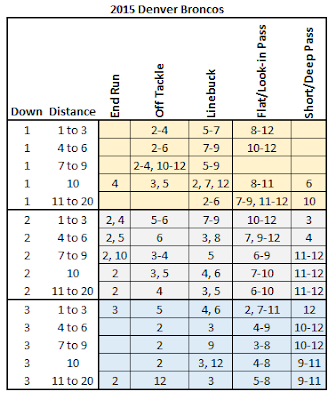 |
| Down and Yard Situation Chart for the 2015 Denver Broncos |
Note that the final chart no longer includes results for 4th down and does not include punts because those plays are highly situational and probably shouldn't be called using a randomized system.


